 An official website of the United States government




Background
Multimodal AI has the potential to capture the complexity of biomedical and behavioral systems and improve clinical decision‑making, but realizing this promise requires new innovations in data fusion, model training, evaluation, and application. Ethical considerations—including privacy, fairness, accountability, and transparency—must be integrated throughout the entire lifecycle, from data selection and preparation to model deployment, with careful attention to stakeholder needs. Collaboration among researchers, patients, policymakers, the scientific community, and end users is essential to co‑create multimodal AI systems that reflect shared values and real‑world requirements. As AI advances faster than traditional funding and development timelines, more flexible and agile approaches to AI research and implementation are increasingly necessary.
Purpose
The purpose of this program is to develop ethically focused and data-driven multimodal AI approachesto more closely model, interpret, and predict complex biological, behavioral, and health systems and enhance our understanding of health and the ability to detect and treat human diseases.
Program Goals
- Creation of ethics- and data-driven multimodal AI models for use in biomedical, behavioral, and/or clinical fields
- Build portfolio of innovative projects that address systems level biomedical challenges using a co-design approach to multimodal AI that integrate the work of various stakeholder groups as appropriate
- Inform considerations for the appropriate use of multimodal AI and take significant steps towards incorporation of ethical and co-design approach in multimodal AI lifecycle
- Use translational or end use applications that will be identified and used as test cases for testing and evaluation
Expected Program Outputs
Mulitmodal AI Awards
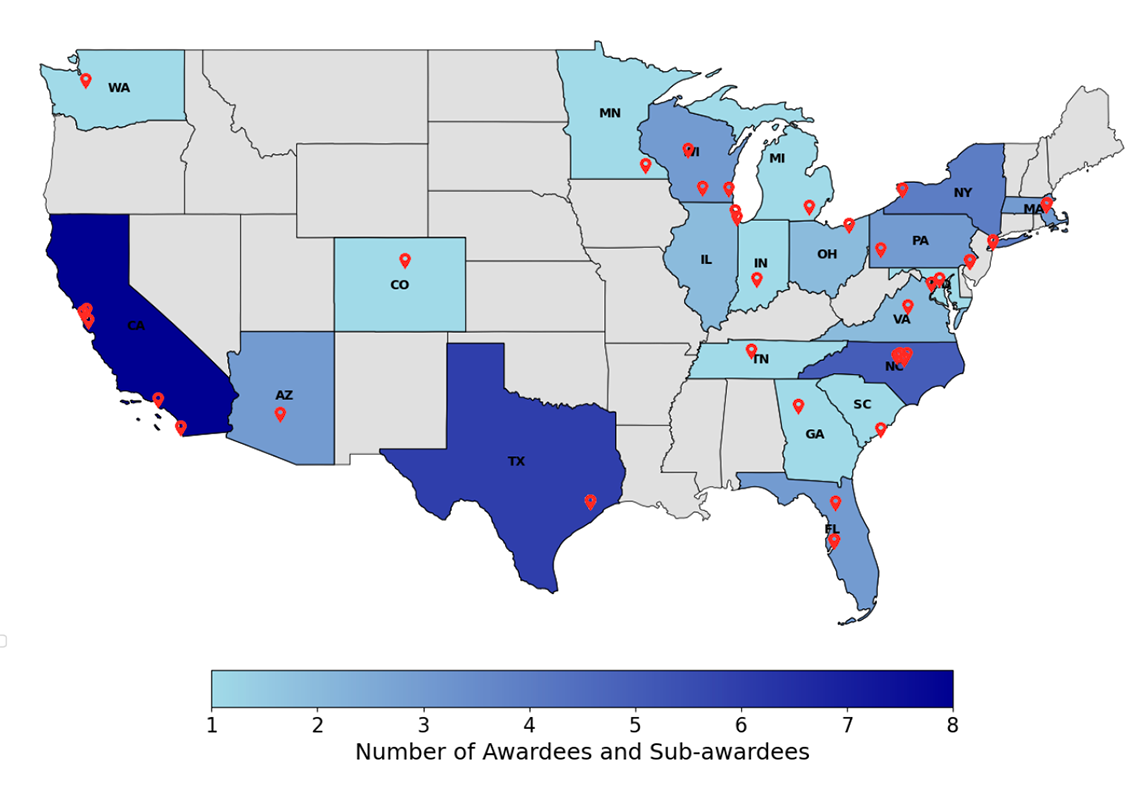
| Lead Institution | Sub-awardees |
|---|---|
| Brigham and Women's Hospital | Massachusetts General Hospital, University of Washington |
| University of Florida | Indiana University, University at Buffalo |
| University of Michigan | University of California Los Angeles, Cornell Medicine, Vanderbilt University, University of South Florida |
| University of Wisconsin-Madison | Marshfield Clinic Research Institute, The Medical College of Wisconsin, The University of Chicago |
| Northwestern University at Chicago | Cleveland Clinic, Cornell Medicine |
| University of Pennsylvania | |
| University of Colorado Denver | Cleveland Clinic |
| University of California Berkeley | UCSF , Stanford University, University of Virginia |
| Baylor College of Medicine | Credence Management Solutions, UT Health |
| Stanford University | |
| Mayo Clinic Arizona | Mayo Clinic (Minnesota - Rochester), Arizona State University |
| University of Texas Health Science Center | UT-Houston, Rice University, UNC-CH, UNC-Charlotte, NC State |
| University of North Carolina | UC San Diego, Moffitt Cancer Center, Wake Forest, Medical University of South Carolina, UT Houston |
| University of Pittsburgh | Duke, UT MD Anderson Cancer Center |
| Stanford University | |
| University of California, San Diego | |
| Emory University | Stanford University, Mayo Clinic Arizona |
| Children's Hospital of Philadelphia | Columbia University, Boston Children’s Hospital |
Research Focus
Contact Information
Please direct questions about Advancing Health Research through Multimodal AI to ODMultimodalAI@od.nih.gov
FAQs
Technical Scope
Application