 An official website of the United States government




Partnerships for Environmental Public Health (PEPH)
Image
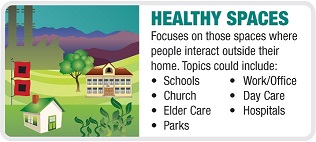
Healthy spaces focus more broadly on the non-household built environments where people live and interact (e.g., schools, parks, workplaces) and how factors intrinsic to these spaces affect human health. Designing the built environment to promote human health encompasses discrete but interactive goals, such as increasing physical activity; reducing injuries; improving air and water quality; decreasing mental health stressors; and providing fair access to livelihoods, education, and other critical social resources.
Resources
- Cleaning Up Take-home Lead Dust in Your Home and Car (University of North Carolina, Chapel Hill)
- Environmental Health Infographics (University of Southern California)
-
- Idling Vehicles (Icahn School of Medicine at Mount Sinai)
- Managing PCBs in Schools (University of California, San Francisco)
- Polychlorinated Biphenyls (PCBs) in Schools: How Children Are Exposed, Health Risks, and Tips to Reduce Exposure (University of California, San Francisco)
-
protect_your_family_from_carbon_monoxide_exposure_508.pdf (303.75 KB) -
spaces_protect_childcare_508.pdf (234.19 KB) -
spaces_protect_garden_508.pdf (291.27 KB) -
spaces_protect_home_508.pdf (133.91 KB) - Resources for North Carolina Community Gardeners (Duke University)