 An official website of the United States government




Predictive Toxicology Branch

Research Summary
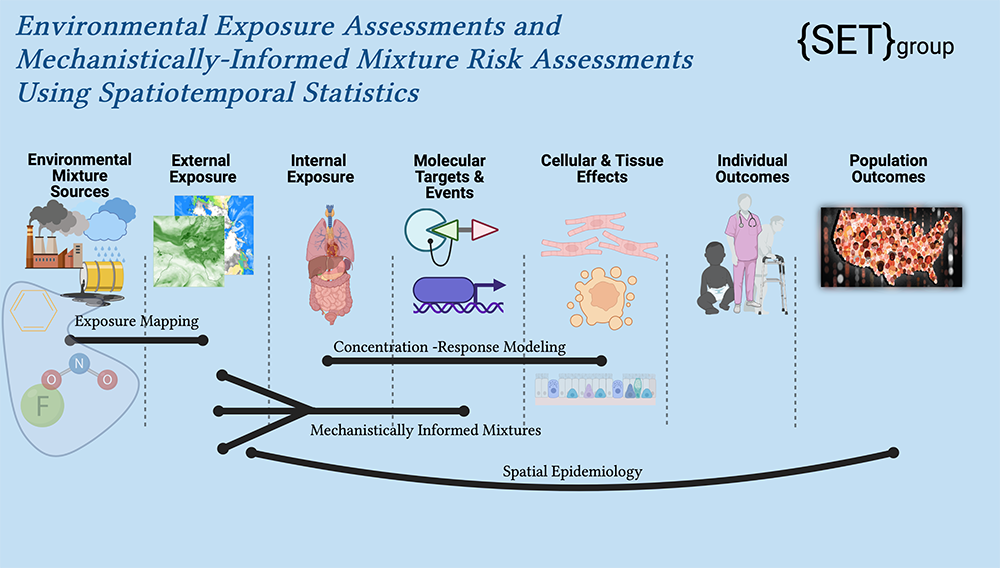
Spatiotemporal models are a class of statistical models that explicitly account for the spatial and/or temporal correlation in data. They have a rich history in fields such mining, forestry, petroleum engineering , exposure science, and most recently, machine learning and artificial intelligence. Within environmental health sciences, there is an ever-growing need for methodological development and applications of spatiotemporal models that can handle the large, complex data and interdisciplinary challenges. Towards this end, the central theme of the Spatiotemporal Exposures and Toxicology Group (SET) is to develop spatiotemporal methods and applications in environmental and human health exposure science while also exploring innovative applications of geospatial and spatiotemporal methods in toxicology.
Currently, the Spatiotemporal Exposures and Toxicology Group is interested in:
- Geospatial exposure, disparity, and risk mapping
- Geospatial mapping of mixture exposure through common molecular initiating events
- Spatiotemporal mapping connections to toxicology
- Toxicokinetic and toxicological-based geospatial risk mapping
The group is led by Kyle P. Messier, Ph.D. Messier is a Stadtman Tenure-Track Investigator in the Division of Translational Toxicology (DTT). He also holds a joint appointment with the National Institute of Minority Health and Health Disparities (NIMHD) in Bethesda, Maryland. Messier received a B.S. in Environmental Studies from the University of North Carolina at Asheville and a M.S. and Ph.D. from the University of North Carolina at Chapel Hill. He also holds a secondary appointment in the NIEHS Biostatistics and Computational Biology Branch .
Scientists & Staff



Zachary T. Stanfield, Ph.D. Contractor Tel 984-287-3215 zachary.stanfield@nih.gov